Warlock Magazine is a monthly black and white 5e focused magazine by Kobold Press which is focused on their campaign world of Midgard which is is a subscription magazine run through Patreon.
A mere USD$3 per month is the minimum fee to access two magazine publications per month in PDF format. Higher amounts entitles you to hardcopies of the magazine. At the time of review there were 734 patrons supporting the magazine.
One publication you will receive each month contains one or two lairs which are short adventures. Each will provide 3-6 hours of adventure depending on your game group’s play style.
The second publication contains Midgard focused lore which is developed but may never have a place in the more official Kobold Press hardcover print schedule. Material varies with each edition and can includes new locations and lore, magical items, new spells, monsters, character options.
Each magazine is approximately 30 pages in length. Two magazine makes it 60 pages per month of content.
Patreon awards come in the form of redeemable coupon codes for the Kobold Press webstore which means you won’t lose access to content you have been given access too if you stop subscribing to Patreon.
The quality of writing and art (all black and white) is first rate – Warlock is not treated as a secondary side project by Kobold Press. Authors – designers who have contributed to the magazine include: David “Zeb: Cook, Wolfgang Baur, Celeste Conowitch, Dan Dillon and Robert Schwalb.
Maps are sourced from Dysons Logos which is a sensible decision as cartography is artwork – and artwork is expensive. It is an excellent example of how a map produced independently can be utilised to create fun filled and inspiring adventures by a creative designer.
Who is Warlock Magazine for?
Warlock Magazine is designed primarily for Dungeons Masters and Players who are looking for additional lore, spells, and class features. The material is based upon Midgard but its all malleable to homebrew or wherever you wish to use it with basically zero effort.
Kobold Press does a particularly good at developing materials for cultures and classes that will provide you a very different perspective from the vision in official Dungeons and Dragons lore.
Joining the Patreon even for a single month to see if it is right for you is well worth it as Kobold Press allow you free access to codes to download material that was published about four months ago. Your $3 monthly subscription goes a long way.
Prospective Authors and Cartographers
Wolfgang Baur the publisher / owner of Kobold Press has said that he is interested in new authors and designers – if you are keen to produce quality material and can meet a deadline and aren’t keen on going it alone or through the DMsGuild process then Warlock Magazine this could be an alternate pathway to publication.
How many 5e Dungeons and Dragons products do you need?
The reality is not much with the free basic 5e ruleset being all that is needed to have both and introductory and medium to long term fantasy role playing experience if you have a creative mind.
Stepping up from this the classic trifecta are the Players Handbook, Dungeons Masters Guide and Monster Manual. Beyond this depends on whether you are a:
Player: in which case Xanathar’s Guide to Everything and Tasha’s Cauldron of Everything would be your next official pickups whilst
But people like me (and probably you if you have read this far), find their bookshelves and computers stuffed with 5e Dungeons and Dragons official and 5e compatible products such as Sly Flourish’s Return of the Lazy Dungeon Master – but also resources from previous editions – but why?
Firstly role-playing games is a very cheap hobby. Yes I know $50 for a book isn’t cheap at the time of purchase, but given the number of hours of entertainment can provide initially and over years and year the cost per hour is very cheap. The products available on DMsGuild are at even cheaper price points with most authors realising they are producing for fun rather than for a profit.
Secondly with the exception of mechanical rules the lore and ideas within each product transcends the editions so you don’t throw old books out. My 1st edition Dungeon Masters Guide remains a key reference document as it contains material that is incredibly useful in a modern game.
Third there is the concept of “lonely fun” which is best described by DMDavid in Episode 133 by Tabletop Babble on the History of D&D Design which explains that there is a large number of people (principally DMs) who enjoy reading material far beyond what they could ever use at the table. DMDavid then goes on to explain that once the lonely fun market is exhausted the only way a publisher can survive financially is to produce a new edition.
Fantasy Books can cast the spell of desire on the unwitting reader.
5e Dungeons and Dragons is special from a collectors viewpoint – and not just because the edition had proved so popular – it is special because Wizards of the Coasts constricted its business activities to a business plan that is financially sensible for the long-term, namely road-testing material prior to release to obtain a measure of user feedback (research and development), and releasing relatively few materials (although this has begun to accelerate).
As Chris Perkins said in his Between the Sheets episode the slow-hard back book release has actually make Dungeons and Dragons more profitable and with more time between publications more time to produce a quality product.
This stepping back from the edge has provided the opportunity for smaller more nimble companies (and individuals) with lower operational costs to enter the 5e market.
For those of us with with a 5e addiction to more content and more lonely fun the answer to how many many Dungeons and Dragons products do I need is: “just one more”.
At the end of a long and difficult year its always nice to sit back open a few Christmas Crackers and read out a few terrible dad jokes. For those of you who like to insert your own jokes into crackers here are a few 5e jokes you can insert.
Q. Why did the Paladin always wear chainmail?
A. Because it is hole-ier than plate.
Q. What’s the difference between a wizard and a sorcerer?
A. Class.
Q. What does Strahd von Zarovich feed his peasants at Christmas?
A. Ghoul-ash.
Q. Who is the noisiest Player Character class?
A. Pala-DIN!
Q. Why is Kobold Press so bad at sports?
A. Because they always play Midgard and never offense.
Q. Why do other actors sigh when they learn that Matthew Mercer will be part of the cast?
A. Because they know he get upset if he doesn’t land the most Critical Role!
Q. What do you call a bard with no hands?
A. No holds Bard
Q. How do you get the attention of another D&D player you think might be your soul-mate?
A. You ask them out on a d8.
Q. What do you call a Tarrasque after it eats all the adventurers?
A. A party-pooper.
Q. Why don’t you tell your DM that they are running The Curse of Strahd campaign wrong?
A. Because the DM is always Wight.
Q. How do you play in Forgotten Realms instead of 5e Adventures of Middle Earth?
A. You need to kick the hobbit!
Q. Why do rogues wear leather armor?
A. Because its made of hide.
Q. If hobbits and halflings both like road-taxes what does this mean?
Campaign Cartographer by Profantasy Software Ltd is a veritable oldie in the world of map-making having commenced operations in 1993 and with more than 250,000 software sales through its various versions, on 3.5″ floppy disc, CD-ROM, DVD-ROM and now digital download storefront. It was even the software platform for the digital release of the Forgotten Realms Interactive Atlas which has become a collectors item for Dungeons and Dragons fans. The software has a strong passionate following including its own Facebook Group of community users but how good is it in a world of competing mapping programs?
Firstly Campaign Cartographer is the first and core component of a suite of mapping tools produced by Profantasy – you must purchase this! on its own Campaign Cartographer allows you to construct world maps but most will want to create battlemaps for online play and for this reason most purchasers should purchase Dungeon Designer and most should also consider purchasing City Designer as well. These are available as a discounted bundle purchase.
Campaign Cartographer User Interface
If you would like to quickly peruse a range of maps recently produced using this software check out the Profantasy blog which is updated at least monthly with maps produced by community members.
Unlike many other programs Campaign Cartographer is not a paint program like Adobe Photoshop, its built upon a CAD (Computer-Aided Design) platform. This means that mapping occurs with symbols, points, polylines and polygons, and these are all laid out in layers (with some layers on-top and some below). The display of the layers can be enhanced using blends, shadows, and bezels to produce a wide range of maps but its not photoshop and new users to the program can become frustrated as it doesn’t operate like the tools they are most familiar with. To get the best out of a tool you do need to learn both the basics and few quirks and Campaign Cartographer is no exception.
To help the designers of the software produce hour long video tutorials that run through the mapping techniques of the various symbol packs that are contained within the base software and the annuals which collections of symbol sets to make different styles or themed maps including sc-fi, isometric maps and carboard terrain for your in person game. Watching a couple will allow you to progress quicker and with less frustration that on your own. Similarly joining the community Facebook Group is very helpful.
What’s it like?
The Campaign Cartographer mapping software allows you to produce a wide range of maps to a very high quality standard. Basic maps can be generated quickly once you have an understanding of the overall concepts. However there are other easier to use mapping programs that can provide a better experience if you are just after something simple and quick and not really that interested in map making.
Dungeon Mapping – John Roberts Style
If you are after a cartography platform that can produce a wide range of maps, styles and customisation the Campaign Cartographer and all the modules it has to produce creations such as star maps then this is the program for you. Profantasy also produce an Annual each year which typically provides a new map style each month for you to enjoy.
Should I purchase Campaign Cartographer?
Campaign Cartographer isn’t the simplest entry into the world of cartography but it is the most comprehensive mapping platform today, providing you with the ability to create almost anything you will want with practice.
In addition to the basic set of symbols users also have free access to the Vintyri Project which provides thousands of additional symbols that will allow you to produce a wide range of maps.
If your goal is to produce the widest variety of maps with the ability to tweak and change most setting and you are willing to take the time to learn its quirks then Campaign Cartographer, Dungeon Designer and City Designers are for you. If not then you are better off selecting a simpler and less customisable mapping suite.
Dungeons and Dragons 5e is notable by the lack of movement that often occurs in combat. Player characters don’t tend to move during combat other than to rush towards an opponent (monks, fighters, and barbarians), whilst others move away (wizards and sorcerers). Clerics, bards, warlocks, and artificers move according to their subclass with melee builds moving forward and support and ranged attackers moving backwards.
In the event combat tends to be somewhat predictable. While predictability is perfectly find and a valid way to play, players and most certainly Dungeons Masters will get more out a combat event if the combat contains a few surprises. Here are some tactics to spice things up.
Add verticality
Adding creating levels in your combat encounters adds difficulty if played to the enemies strengths. Beholders, Dragons and Chimera, won’t line up to be punished by your barbarians and fighters when they have range attacks which they can rein down on characters. Humanoids too use height to their advantages. Think archers and ranged spellcasters in the gallery level protecting their queen.
Going low use water, fetid muds, quicksand, and lava as potential travel routes for creatures beneath the gaze of characters. There is nothing to stop a fire giant from diving into a pool of lava, holding their breath and after a short hidden swim rising to try and snatch a hapless character joining them in their fiery pool.
Responding to these threats will require characters to move use, use resources to engage or retreat successfully.
Throw in a dead magic zone
Used sparingly dead magic zones are incredibly tool for a protagonist who doesn’t have access to the magic held by the party. Dead magic renders may common tactics of parties inert. Spirit Guardians, Fireball, Polymorph, and magical weapons and items.
A creature such as a lycanthrope that is immune to non-magical weapon damage suddenly becomes an unassailable threat.
Use darkness to your advantage
By design many monsters have darkvision of 120ft compared to the players typical 60ft. Nothing threatens players more than a hail of arrows appearing out of the darkness from an enemy they cannot see. This particularly works well when using driders as even when the characters surge forward into the large cavern they discover their foe sits safe and high on the ceiling above.
Provide cover to spellcasters
Combat savvy creatures such as hobgoblins understand the battlefield advantage provided by spellcasters and they would be a strategic asset for them to protect. Assign key spellcasters with support troops who carry tower shields who will use their action and reaction to provide mobile cover to their spellcaster. When they are attacked by spells requiring a dexterity save both the spellcaster and shield carrier would take no damage on a successful save and only half damage on a failed save.
Use the environment to your advantage
Walls of force, eruptions of lava, obscuring smoke or steam are effective ways of transforming the battlefield into discrete zones. Elevators lifts, gantries cliffs, and tipped over vats of acid or molten metal can quickly transform a what was a simple location into something far more complex.
Combinations of trouble
Don’t limit yourself to a single option of harassing the party. But try not to use more than 2 at a time else you will struggle as a Dungeon Master to keep track of it all and risk upsetting your players with what could be perceived as excessively adversarial tactics from a combative Dungeon Master.
Everyone loves a bargain and while Black Friday to Cyber Monday shopping period opens wallets and purposes for those looking for a bargain some people are looking for that special something that is a little more unobtainable or special for the role-player in their lives.
So if you have deep wallets, or a generous heart and a smaller wallet here is our list of the most expensive Christmas and birthday gift ideas we could find. Unlike many other lists none of the ideas are sponsored and there are no affiliate links – enjoy.
Rode VideoMic NTG (USD$249)
2020 and COVID19 makes this the year of the digital Dungeon Master and Player which means virtual gaming sessions and a need for great video and audio quality.
Rode VideoMic NTG
While the Sure SM7B condensor microphone is very commonly seen and a good deal more expensive it has two flaws. One it dominates the view of your face if you are video streaming and using it correctly and secondly its more complex to set up. The Rode VideoMic NTG connects via a USB connection and you can also use it on the road attached to your camera. It also has an optional outdoor housing so you can play outside in the rain or snow if you so wish.
Designed by a new audio company Austrian Audio which is staffed by former employees of well known AKG the Hi-X55 headphones stand out due to being engineered for music perfection. Shunning 50mm drivers for 44mm as they worked out that bigger is not always better, this foldable, and cord replaceable headphone set will provide you with a premium listening experience whether you want to play a game, listen to podcasts, or indulge in music.
Hi-X55 Headphones
Hindenburg Journalist Pro (USD$375)
So the person you are looking for wants to turn their gaming group into Podcasting Rockstars then you should pickup a copy of Hindenburg Journalist Pro which is specifically designed for podcasting and radio production to tell stories. Available for PC and Mac it provides a simple yet powerful interface to record, edit and publish.
If your budget doesn’t stretch that far and you don’t plan to record more than one person or source at a time or plan to record using a different device then you purchase Hindenburg Journalist for much less.
Hindenburg Journalist Pro
Perfect Pencil Magnum (USD $395)
Manufactured by Graf Von Faber-Castell the perfect pencil is available in 7mm and 10mm diameter and is perfect for writing and sketching. Thanks to the characteristic fluting shape it is pleasing to hold and offers supreme writing comfort. A 4B lead provides a pleasantly soft writing experience when you have to tick the final box for your last failed death save.
Perfect Pencil Magnum by Graf Von Faber-Castell
The pencil comes with either a platinum-plated, or rose-gold end cap which includes both an integrated sharpener and eraser ensuring you have everything you need in one place.
A brown / black version also exists for the chaotic evil player for USD$450.
For those of you without the USD$395 you can purchase a 3 set of replacement pencils for a mere USD $29.
100 micron 4d6 Dice (USD $800 per die)
These mind bogglingly small brass six sided die by Japanese firm Iriso Seiumitsu each take 9 hours to manufacture weigh 0.00016grams and 20,000 would fit into a 1cm cube.
The 100 micron sized die (under the microscope)
A set of 4 to roll up your perfect character would set you back USD$2,400 and you will never find them should you roll them off the edge of the table.
For those of you concerned about unbiased dice they manufacturer regular sized d6 dice the call the Perfect Dice with an accuracy tolerance of 99.99999999%.
DM’s Flight Chair – MFC-1 Blackbird (USD$815)
A new product to market made by gaming controller company Monster Tech the MFC – 1 is designed for flight simulators and space games like Star Citizen and Elite Dangerous.
Unlike gamer chairs which are modelled off road seats this chair is high backed and tapered from the shoulders down which allows Dungeon Masters and Players the ability to move their shoulders about with complete freedom and comfort which makes for a better show when when streaming yourself online.
its worth noting that as the chair has been properly designed for your back like an office chair it doesn’t need the pads and cushion on gaming chairs. All the height and lean adjustments you need are here.
MFC-1 Blackbird
Each chair is made by hand, exclusively from parts from Germany and the EU. The fabric is a new breathable and water-vapor-permeable synthetic leather made of vinyl and polyurethane which provides both surface softness and durability
Samsung G9 49″ QLED Gaming Monitor (USD$1479)
With so much Dungeons and Dragons being played virtually using Fantasy Grounds and other virtual table top system a huge, fast and vibrant gaming monitor that allows the Dungeon Master or Player to have all their resources (VTT, Syrinscape and Communication client) in their field of view.
Samsung 49″ G9
Samsung’s 49″ G9 QLED Gaming Monitor is a CR20 gaming beast and providing you have a large enough desk its of artefact status.
The Prophecy Gaming Table (USD$10,000+)
Made by the uncompromising wood working company Wyrmwood Gaming. The Prophecy contains all the bells and whistles. Designed to accommodate 6-10, packed with features and built to last a lifetime. Wrymwood Gaming believe it to be the finest gaming table ever made.
Wrymwood make this table available for USD$5,000 but we doubt any serious gift giver would spend so little as the table at this price point is missing the components that really make it shine including topper, cup holders, and more exotic wood options. You can get to $20,000 no problem.
Created during the early years of Dungeons and Dragons and inspired by science fiction the mindflayer (also know as the illithid) is now one of the most iconic monsters of Dungeons and Dragons. These former lords of the multi-verse now hidden have a plethora of information available to state the lore hungry Dungeons Master or Player.
The blog The Monsters Know What They’re Doing has a post which outlines the tactics these creatures would likely use in a combat encounter.
Videos:
Mindflayers – including Elder Brains
Mindflayer Lore with Chris Perkins from Wizards of the Coast
Wed DM: Mind Flayer
AJ Pickett – Deep Dive into Law
MrRhexx – Mindflayer Lore
Ceremorphosis
Mindflayers require a host to come into existence. A mindflayer tadpole is placed into a host’s brain usually via the eye. When ready the tadpole takes over the form of the host and becomes a mindflayer the process of which is shown in this trailer for the Baldur’s Gate 3 game trailer.
The Korean themed Koryo Hall of Adventures: Adventure’s Guide to Jeusung for 5th edition Dungeons and Dragons (Pathfinder 1 conversion document also available) caught my eye immediately when it launched on Kickstarter in 2019 as an Asian inspired campaign setting.
Asian inspired campaign settings are rare. Most Kickstarter’s target Norse, Athenean, Romanesque, or Grim-dark settings presumably as this is where the gaming market is perceived to be, or there are so few people in the hobby that have the time and knowledge to write such a book.
Kickstarter Launch Video for Koryo Hall of Adventures
The 1st Edition Advanced Dungeons and Dragons book Oriental Adventures is often criticised for its portrayal of Asian cultures as reinforcing bad television stereotypes but at 144 pages it was never realistically going to accurately portray more than two thousand years of diverse Asian history and culture in a way that was commercially appealing in a predominately US market.
So how does this book compare?
The book has a single author who has been a resident of South Korea for more than 10 years. Turning though the pages you can see that the author’s life experience and passion of Korean culture has been poured into this 272 page book.
The main sections of the book are:
A mythology and history of Jeosung – which explains the creation of the world, departure of the gods and the current state of the world
The people of Jeosung – an explanation of how the races in the Players Handbook fit into the world (including Dragonborn and Goliath), and social hierarchy
Agencies and Factions – introducing government agencies and organisations you can use to breath life into the world
Visualizing Jeosung – the part of the book that most directly draws from Korean culture: architecture, farming practices, food and drink, treasure and musical instruments are all outlined providing Game Masters with knowledge on how to frame life in Jeosung
Gazetteer of Jeosung- a tour of the continents, including notable location, events, and NPC’s
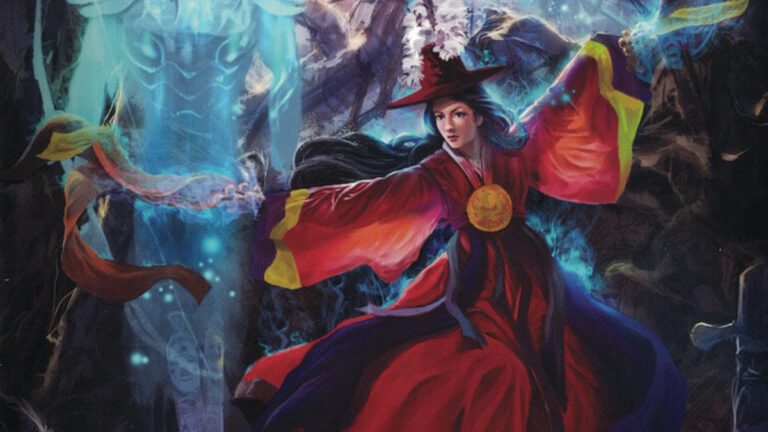
New NPC classes Mudang (Spirit Shamans – which are structured somewhat similarly to 5e warlocks but powered by a spirit (momju) that inhabits the shared space of their physical form
New subclasses for Bards (College of Gwangde – a performance bard) and Monk (Sunim – martial spiritualist in the attainment of purity)
New magic items
New spells
New Monsters – drawn from Korean themes.
The book is well written, contains thoughtful and beautiful culturally aligned commissioned artwork and presents a world and culture that is foreign compared to the typical medieval-esq Dungeons and Dragons world whilst still being accessible to Western Readers.
At times, the title strays towards novel rather than technical manual which presents a structured who, what, when where and how for a game master to play within. I think the inclusion of a novel styled components between the technical components was a deliberate design choice to increase immersive flavour of a different culture, it achieves this goal, but it is different to how Wizards of the Coasts presents a campaign setting (like Ebberon).
My impression is that the book may have benefited if it had focused in precise detail on a small number of adjacent provinces with lots to do rather than attempting to present a campaign sized world. Not all campaigns need be as large as Forgotten Realms most Wizards of the Coast adventures are contained within a small geographic area so players and game masters don’t have to absorb and be familiar with an enormous amount of lore to be accessible. If I were running this campaign world I would crunch its content into a smaller geographical area.
Overall the Koryo Hall of Adventures: Adventure’s Guide to Jeusung presents a land and culture that is foreign and very different to the only other asian-themed than the 1st Edition Advanced Dungeons and Dragons book Oriental Adventures. If you want an asian inspired campaign setting written by someone that has lived in an asian culture for an extended period of time you should consider picking this title up.
The hardback version of this book was published in South Korea and survived the courier journey to Australia in perfect condition. If you are thinking of getting a copy the publisher is ensuring books are packed and ready for a long safe journey. A digital version can be purchased from DriveThrRPG or publishers website.
It is also available in a Korean language version, which is a nice touch.
The Kender from the Dragonlance campaign setting is widely regarded as the most despised player race in Dungeons and Dragons due to Players using the the lore of the Kender to mercilessly steal constantly from other players.
This pattern of behaviour exhibited by players is contrary to the Kender lore in the AD&D Dragonlance Adventures source book.
“TO BE CALLED A THIEF IS STILL CONSIDERED A BASE INSULT.”“
The lore clearly states (pg.52) “Kender do not steal for the sake of profit. Firstly they have little concept of value, faced with a choice between 2,000 steel piece diamond and a huge, glittering chunk of purple glass, 90 out of 100 Kender will take the glass” and “On the other hand, Kender, like everybody else, do not like the idea of someone deliberately tasking an item from someone else without the latter’s permission. To be called a thief is still considered a base insult.”
The Dragonlance Adventures develops the concept of “Kender Pockets” essentially the player keeps a list of 100 items the player must invent and then track. Furthermore 93 of the 100 items are required to be little more than belly button fluff. This is problematic due to the amount of book-keeping required and it requires one player to decide which items they may have taken from an other player. If known to another player this will likely cause conflict.
…Kender’s borrowing tendancies…
Within the Dragonlance novels the Kender’s borrowing tendencies was used as a story device to ensure the party had the right item a the right time – borrowing wasn’t used on a constant basis. Factoring both Dragonlance Kender lore and how Kender Tasslehoff’s Burrfoot ability was used in the novels to drive the narrative, the 5e trait to represent this is:
Lucky possession. Kender have a knack for having the right item in their possession at the right time. Once per long rest you can name any non-magical item up to 2lb in weight that is no larger than a dagger that you may have reasonably seen and been in close proximity too in the last two days provided the item is not your immediate vicinity and not used since you observed it by another creature. Make a DC 10 Wisdom check if the item was not owned, or owned or carried by a friend or ally, if not the DC is the item owners passive perception. On a successful roll the item just happens to be in your possession. A failed roll the item wasn’t that interesting at the time and you didn’t try to collect it.
At 5th level your lucky possession item may include a magical item from an ally. At 12th level you may use your lucky possession ability twice per long rest.
The design of lucky possession removes the compulsion to thieve from other players and turn the ability into a limited use survival talent. It also allows other players to make suggestions on what the Kender may have taken that would help get the party out of a pickle.
To make a 5e Kender Race
Purchase the Dragonlance Adventures sourcebook from DMsGuild for lore.
Apply the halfling base traits.
Use the Gnome height and weight – Kender are are changed gnomes but halfling works best for their traits.
Subrace Kender.
+1 Wisdom
Darkvision. 60ft
Lucky possession (as above)
Clear vision: You have advantage on saving throws against illusion and charm spells. A Kender may use its action to end one charm or illusion effect on itself.
Fearless: You have advantage on saving throws against fear.
A common complaint in role-playing games including Dungeons and Dragons is figuring out what can players do with all the gold and treasure they collect.
There are a myriad of suggestions but some such as buying magic items will make make a Game Masters life more difficult as more magical items results in the players becoming more powerful which can be harder to design games around.
A common suggestion is to require players to establish a base or fortress. However players invariably expect this base to be attacked, and in the same way that most 1st level adventurers are are friendless orphans so the Game Master can’t threaten them players will also spurn bases. It doesn’t help that 5th edition Dungeons and Dragons focus on heroic action means base building hold’s little appeal.
In that case how does a Game Master make players spend their hard earned wealth. Well the answer is simple – sit one or more goals or objectives behind success at the gambling table. Best of all – it works whatever the player level.
The Tiefling owner of the Lucky Centaur gambling den looks across at the table at you and gives a wry smirk “I have the information you want but let’s find out if Lady Tymora thinks you should have it. Put up 500gp and I’ll give you a chance to have it at a discount.”
A word of warning. Don’t do this if your players in real-life have genuine gambling issues, or have partners that do. Real life gambling addiction is very serious and not to be trivialised – but if you don’t – gambling can provide for an entertaining gaming session. If the players are lucky they will obtain what they need – if not they need to go adventuring again so they can put up the wager once more – and hope lady luck shines on them.
Here are three simple gambling games for your table. Each is a simple dice game, quickly learnt and played and accessible for virtual table top groups.
Dice games are easy to play using a virtual table top
Game 1: In Between
Player rolls 2d20.
The player must then roll a 3rd d20 and get a number between the values shown on the 2d20s.
If the numbers rolled on the first 2d20 values are the same or there is no gap between the numbers then player automatically looses.
If the player succeeds the Payout rate is 5:2 (for every 2gp bet they get 5gp)
Make your life easy and only accept bets in certain ratios
Bet Amount
Payout Amount
2sp
1gp
6sp
1gp 2sp
2gp
5gp
10gp
25gp
20gp
50gp
50gp
125gp
100gp
250gp
200gp
500gp
500gp
1250gp
1000gp
2500gp
Payout table for In Between
The odds always favour the house
Game 2: Under and Over
Players bet if the value on 2d6 will be more or less than the number 7
If the value on the 2d6 equals 7 all players loose
The Payout rate is 3:1
Make your life easy and only accept bets in certain ratios
Bet Amount
Payout Amount
2sp
6sp
2gp
6gp
10gp
30gp
20gp
60gp
50gp
150gp
Payout table for Under and Over
Game 3: Two-up
The player calls either 1 or 2 “The Bet”
Roll 2d2
If “The Bet” occurs (both dice show the same value) the player wins and is paid out
If “The Bet” is anything else the player looses
The Payout rate is 15:2
Bet Amount
Payout Amount
2sp
1gp 5sp
2gp
15gp
10gp
37gp 5sp
20gp
75gp
50gp
187gp 5sp
Payout table for Two-up
Cheating
Invariably players will want to cheat the house. This is fine and you should consider allowing it but in a world where magic is known to exist players should expect operators of gambling facilities to have protective measures in place. Detect magic, see invisibility, mind shielding are common protections. A more cautious gambling operator may host their games inside a dead magic zone.
Players should be aware upfront of the consequences of being caught cheating. Consider having an NPC patron caught cheating and the casino respond to this event in suitable fashion as soon as possible after player entry to make it clear to the PC’s that such a course of action entails high risk (possibly fatal).
Unusual Wagers
Don’t limit yourself to gold and treasure as the potential wager go fantastical if the knowledge or item they hope to secure by winning is high stakes. Think the bottled lie of a Sphinx, water from both Elysium and the River Styx, or the Rod of Seven Parts. All these paths lead to the adventure you want to run and the goal that the Players want to achieve.
Bet what you don’t have…
This being a fantasy worlds players can wager what they don’t have in return for a quest or obligation if they loose. Players who owe money or favours provide Game Masters with opportunity to push the game forward.
Good luck players! and remember – the house odds always favour the Game Master!